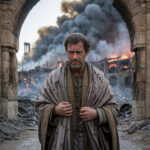
He Carried Ottoman Gold Through Fire, Then Died Poor: Musa’s Unforgiven Sacrifice

The desert night did not feel like night.
It felt like a lid pressed over the world—heavy, airless, indifferent. Somewhere beyond the dunes, the rails of the Hejaz line waited like a thin vein of hope, always threatened, always watched. And somewhere closer—too close—voices moved in the dark: men, many men, the kind whose numbers make courage feel like a mistake.
Musa held his reins with hands that looked made for stone, not rope. He was barely in his twenties, but the silence around him was older than empires. The caravan disguise sat awkwardly on his shoulders—merchant cloth over a body built for war—yet he kept his face calm, as if calmness itself were a weapon.
Behind him, the weight was not only the saddlebags.
It was the empire’s breath.
Three hundred thousand gold coins—promised for Yemen, promised for survival—were divided between groups like a secret that could kill the tongue that spoke it. Musa led the small advance party, ten men moving like a shadow ahead of Eşref Sencer Bey’s larger unit.
And Eşref’s last instruction burned in his mind, simple and cruel:
“If we are attacked, you do not come back. You go forward.”
Musa had nodded without speaking. Some vows are too heavy for words.
Now, far ahead, the land narrowed into a pass. The name would later sound ordinary on paper—Hayber, Cembele—yet in that hour it felt like the throat of fate itself.
A faint sound rose, then multiplied: footsteps, whispers, the clink of metal, the restless breathing of thousands.
Musa’s men shifted, terrified.
Someone asked, almost childlike, “How many?”
Musa did not answer. He already knew.
And in that moment—before the first shot, before the first fall—Musa understood the real tragedy:
The empire would never remember how frightened its loyal sons were.
It would only remember whether the gold arrived.
Musa’s story began far from the desert where it would almost end.
His fathers were Sudanese, but he was born on Crete—around the 1890s—because his own father served there. In the old Ottoman world, identity could be a road rather than a cage: a child could belong to a people by blood, and to a state by devotion.
When Musa was still young, his grandfather took him to Cairo.
Not for wealth.
For language.
In Cairo, they lived in a Turkish quarter, among voices that carried the cadence of Istanbul and the prayers of a shared empire. The old man wanted Musa to learn Turkish well—to think in it, to dream in it, to feel the Ottoman idea not as propaganda but as home.
Musa learned quickly.
He grew into a young man with a powerful body and a strangely quiet heart. He was the sort of youth people stared at without meaning to: tall, broad, athletic, with the strength to lift two heavy grain sacks—eighty kilos each—and carry them as if stubbornness itself was a muscle.
Yet what made him dangerous was not strength.
It was loyalty.
When Italy moved to occupy Tripolitania (Trablusgarp), Musa—still in his early twenties—could not bear to stay behind. He went to join the Ottoman volunteers. He did not go because he expected medals. He went because the empire’s pain had entered his chest like a permanent ache.
In the desert wars of North Africa, he found something darker than battle: the world’s cold appetite for Ottoman lands.
And there, among officers and irregulars, Musa caught the attention of a man who did not waste his gaze: Eşref Sencer Bey, the intelligence chief—what later generations would call the head of the Teşkilat-ı Mahsusa.
Eşref did not ask Musa if he wanted glory.
He asked if he wanted duty.
He took Musa close, making him a guard, a companion, a living shield. Musa became known by the nickname that carried both affection and ownership: “Eşref’s Arab,” “Eşref’s commando.”
Not because Musa lacked his own name.
But because the empire often renamed those it used.
The seed of tragedy lay there too: Musa’s life would be spent carrying the state on his back—yet he would never be allowed to become important in the state’s memory.
In the early twentieth century, the Ottoman Empire was still called a “great state,” but it was a greatness filled with cracks.
The real “palace” of Musa’s story was not marble. It was the machinery of war—offices, telegrams, coded instructions, the grim rooms where decisions were made with ink and paid for with blood.
Across those rooms, the great powers—Britain, France, Germany, the entire constellation once called düvel-i muazzama—shared a blunt assumption: the empire was a prize waiting to be divided.
Britain’s eyes fixed on the routes that fed its imperial heart. The Basra Gulf and Şattü’l-Arab, the security of the Suez Canal, the Red Sea, the desire to seize Palestine and Jerusalem, and always—like a second breath—an interest in the Straits.
To reach from the south, Britain needed something more effective than armies alone.
It needed a fracture inside Ottoman lands.
An Arab revolt.
And the most suitable figure became Sharif Hussein in the Hejaz, aided by British influence and by the efforts of the agent history remembers too easily: Lawrence. British naval power supported coastal cities like Jeddah and Yanbu, limiting Ottoman reach. Over time, the revolt spread until rebel forces—guided and supported by British and French officers—moved close to Medina, pressing from north and west.
Rail lines were sabotaged relentlessly. Small Ottoman detachments were attacked. The distance between Medina and Yemen became not a road but a wound.
In Yemen, the 7th Corps under Ahmet Tevfik Paşa was increasingly isolated. Help could not arrive in ordinary ways, because “ordinary” had been killed by revolt, sabotage, and geography.
In Istanbul, the acting commander-in-chief, Enver Paşa, called the man who knew the region best.
“Eşref Bey,” he asked, “what do we do?”
Eşref proposed a plan that sounded like desperation shaped into strategy: send large sums—150,000 gold to support Imam Yahya’s loyal forces and create camel cavalry units; and 150,000 gold to Ahmet Tevfik Paşa, who was trapped and starving for resources.
Three hundred thousand gold coins.
But the question was brutal:
How do you move gold through a land ruled by ambushes?
Inside power, this was the daily life: not speeches, but unsleeping arithmetic—how many men, how many coins, how many miles of betrayal.
And somewhere inside that arithmetic stood Musa, silent, waiting to be spent.
Gold does not travel like water.
It travels like guilt.
Enver Paşa approved the plan. The gold was taken from the ministry responsible for provisions. Eşref Sencer Bey formed a volunteer unit—forty, perhaps fifty men—the kind of force that today would be called special operations. They changed clothes, adopted the disguise of traders, blended into the world that was hunting them.
They reached Medina.
And there the problem became worse.
Medina was under pressure, defended by Fahrettin Paşa, whose name would later become synonymous with stubborn loyalty. He warned Eşref: intelligence suggested a massive rebel presence—numbers so overwhelming that forty men moving openly would be annihilated.
Eşref did not argue with the numbers.
He argued with necessity.
He split the mission.
Musa was given command of a smaller advance group—ten, perhaps twelve men—and entrusted with the gold. They would go ahead, moving like a merchant caravan. Eşref would follow with the larger group at a distance. They kept several kilometers between them, watching with binoculars, as if distance could be turned into safety.
And Eşref gave Musa a command that was not a command but a severing:
“If we are attacked, you continue. You do not return. You do not come to us.”
It was the kind of instruction that kills something human inside a loyal man. Because it demands you accept, in advance, the death of those behind you.
They traveled for days.
Heat by day, cold by night.
The pass near Hayber.
Then Cembele.
And there, the world opened its mouth.
A force appeared—enormous, like a moving wall: not a skirmish, not a raid, but something that made the mind refuse to calculate. Twenty thousand against forty. A number so unfair it felt almost supernatural.
Eşref’s unit was attacked.
And they fought.
Not because they believed they could win.
But because losing fast would make the mission meaningless.
For a full day, those forty men held—against a force that should have swallowed them in minutes. The desert heard gunfire, shouts, the ugly percussion of a stand that was never meant to succeed.
Musa’s smaller party, ahead, did what Eşref had ordered.
They did not turn back.
They went forward.
Later, Eşref survived wounded, with one or two others. The rest fell—nearly all of them. The attackers searched the dead, the animals, the supplies.
They found no gold.
Somewhere, far away, Musa kept moving, carrying the empire’s future like a curse that must not be seen.
Weeks later, in Yemen—at Sana’s garrison—Musa arrived.
Not as a conquering hero.
As a shadow dragging sacks.
Ahmet Tevfik Paşa had already received a telegram from Enver Paşa saying the convoy had been ambushed and the gold seized. Hope had been extinguished on paper.
Then Musa stood at the gate and said, simply:
“We brought the gold.”
They counted.
The coins were there.
Three hundred thousand.
Perfect.
The historical turning point was not a battle.
It was a delivery.
Because an isolated front can survive hunger longer than it can survive abandonment.
And Musa, a Sudanese-born Ottoman in spirit, had prevented abandonment from becoming fate.
After the gold was delivered, Musa rested only briefly.
Rest, for men like him, was always temporary and always punished.
He returned toward Medina with his small group—now without the burden that made them a walking target. They reached Fahrettin Paşa’s area again. How long Musa stayed there is unclear in records, but the outline of his life is: he remained in the harsh orbit of war until the years of the National Struggle approached.
Then came the deeper cruelty:
Peace did not reward him.
Empire collapsed. Occupation arrived. And Musa, who had carried Ottoman wealth through the desert, returned to Istanbul not to claim a place, but to serve again.
He went to Beyazıt Mosque, praying the afternoon prayer like a man asking not for comfort, but for endurance.
When he left, he met Ali Sait Paşa, a former commander from Yemen’s Aden region—someone who recognized Musa’s face beneath the exhaustion and the poverty.
Musa was in rough shape. His clothes were worn, his body still immense but drained. Ali Sait Paşa took his arm and offered a practical kindness:
“Let’s arrange your retirement pay. Write the petition. I will sign it.”
In a world where officials survived by securing benefits, it was a generous offer.
Musa refused.
And his refusal was not theatrical. It was devastatingly moral.
“I cannot take retirement money from this poor nation,” he said. “The state is already slipping away. The homeland is occupied. How can I take from the treasury?”
This is where Musa’s tragedy became intimate.
Not the tragedy of bullets.
The tragedy of conscience.
He chose hunger over comfort, because he could not bear the thought of feeding himself with what belonged to a wounded people.
With Ali Sait Paşa’s support, Musa began working as a porter at Galata Customs—hauling loads for survival. The hero of desert missions became a laborer beneath the gaze of occupation.
Then fate staged a cruel scene.
The occupation forces’ commander, General Harrington, came to inspect Galata Customs. He saw Musa carrying loads—this giant of a man—and asked who he was.
An intelligence officer replied with the kind of recognition that is more dangerous than forgetting:
“That is the man who carried the 300,000 gold to Yemen.”
Harrington approached, through a translator, offering Musa exactly what the world believes can buy any man:
“Work for us. I will drown you in gold.”
Musa’s response was quiet, but it cut deeper than anger:
“Not every offer is made to everyone. I am deeply disturbed by your words. Our business is not finished. Our struggle will continue.”
It was not a threat screamed with bravado.
It was a promise spoken with dignity.
In that moment, Musa transformed again—not into a soldier, not into a porter, but into a symbol of the one thing occupation cannot fully crush: a man who cannot be purchased.
He continued helping the National Struggle, including efforts to smuggle weapons. He lived by labor, not privilege.
And then, slowly, the body that had crossed deserts began to fail.
Musa did not die on a battlefield.
That is the bitter irony.
He died the way many invisible heroes die: quietly, poorly, and too early.
Years of exhaustion, harsh living, and relentless strain weakened him. He fell ill with what the era called the “thin disease”—tuberculosis. Even then, he refused comfort that felt undeserved.
Ali Sait Paşa offered to place him in a sanatorium.
Musa declined again.
“I cannot benefit from the state’s hospital,” he said, insisting others needed it more. He claimed he was fine, even as his body betrayed him. Pride did not keep him from begging; conscience did.
He came to Özbekler Tekke, attaching himself to Sheikh Ata Efendi. In the calm rhythm of the lodge—prayer, humility, service—Musa found the only kind of shelter he trusted. He lived there for a short time—three months, perhaps six. No one can say precisely how long. Illness does not keep calendars.
Then, sometime in 1920, around the age of thirty, Musa died.
He was buried in the tekke’s cemetery, not beneath a monument, but beneath the earth—simple, final, merciful.
Who gained power?
Not Musa.
The occupation authorities kept their control for a time. The world of politics moved on, as it always does.
Who lost everything?
Musa lost what most heroes lose: time, health, recognition. He gave the state his youth, then gave the nation even his right to be cared for.
His fate was historically consistent with the cruelty of the era: empires collapse loudly, but the men who tried to hold them together often disappear in silence.
History remembers empires through generals and treaties.
It remembers Enver Paşa’s desperate calculations, Fahrettin Paşa’s defense of Medina, the vast chessboard of revolt and sabotage, the great names that fit neatly into textbooks.
But history struggles with men like Musa.
Because Musa does not fit the convenient categories.
He was Sudanese by ancestry, born on Crete, raised in Cairo’s Turkish quarter, loyal to an Ottoman ideal that was already dying while he carried it. He was an irregular, a guardian, a commando, a porter, a sick man in a lodge—yet through all these skins, he stayed the same: a conscience wearing a body.
His story is tragic not only because he died young.
It is tragic because the world offered him the two temptations that destroy many souls—money and comfort—and he rejected both, even when his lungs were failing.
It is tragic because the empire he served could not save him when he needed saving.
And it is tragic because, after all that gold, all that fire, his grave remained humble.
Yet perhaps that humility is the sharpest indictment and the deepest honor at once:
Musa did not ask history to remember him.
He only asked God to accept what he could not stop himself from giving.
He carried the treasury through the desert, then refused a single coin from the poor.
When the occupier offered gold, he offered dignity instead.
Some men die once—Musa died slowly, in the silence between gratitude and forgetting.
News
Bağdat’ın Son Halifesi ve İnsanlığın Kırılan Beş Yüz Yıllık Kalemi
Bağdat’ın Son Halifesi ve İnsanlığın Kırılan Beş Yüz Yıllık Kalemi Dünyanın Kalbinin Durduğu Gün: 1258 Bağdat Felaketi 13 Şubat 1258’de…
Kandil’in Sessizliğinde Bir Gece Yarısı ve Zirvedeki Al Bayrak
Kandil’in Sessizliğinde Bir Gece Yarısı ve Zirvedeki Al Bayrak Kandil’de Şafak Vakti: 12 Saatlik Sessiz Yürüyüş Kuzey Irak’ın Kandil dağları,…
İmkânsız Denilenin Ardında Saklı Sessiz Bir Yılanın Kararlı Hikâyesi
İmkânsız Denilenin Ardında Saklı Sessiz Bir Yılanın Kararlı Hikâyesi Brezilya’nın 1944’ten önce Avrupa’daki bir savaşa asker göndereceği düşüncesi, o zamanlar…

Bağıran Odaların Sessiz Ustası ve Eğilen Mağrur Başların Hikâyesi
Bağıran Odaların Sessiz Ustası ve Eğilen Mağrur Başların Hikâyesi Samet Bey, çevresinde her zaman bir korku çemberiyle yürürdü. Yurt dışında…
Karanlık Suların Altında Bir Mabedi Omuzlarında Taşıyan Adam
Karanlık Suların Altında Bir Mabedi Omuzlarında Taşıyan Adam Yıl 1906. İngiltere’nin gururu, Winchester Katedrali sessiz bir felaketle yüzleşiyordu. 900 yıllık…
Bereketi Kaçan Buğday ve Bir Fısıltıyla Kararan Kardeş Payı
Bereketi Kaçan Buğday ve Bir Fısıltıyla Kararan Kardeş Payı Bozkırın ortasında, toprağın rengiyle bir olmuş bir köyde iki kardeş yaşardı….
End of content
No more pages to load