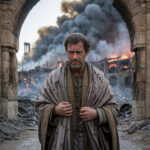
He Took Egypt, Took the Caliphate—Then Died Whispering Yasin in Lonely Edirne Roads

The candlelight trembled the way a soldier’s hand trembles after battle—trying to look steady, failing anyway.
Hasan Can stood at the bedside with his palms open, not in prayer yet, but in readiness. He had served rulers, watched strong men fall, watched doctors lie with polite faces. Still, this night felt different. Not because the room was grand—rooms are always grand around sultans—but because the air had changed.
Yavuz Sultan Selim Han—Egypt’s conqueror, the man who had bent the Mamluk crown into history—lay with a body that no longer obeyed his will. The pain was not loud. It was worse: it was patient. It returned again and again, like a siege that never announces the hour of assault.
Outside, the world moved as if nothing could end. Plans still existed. Maps still waited. The navy still needed orders. Portugal still pressed the seas. Rodos still lingered as an ambition that demanded perfect preparation. Even the treasury—so full it seemed to mock poverty—could not buy one more breath.
Selim’s eyes opened with effort, and in that effort there was a cruel irony: this man had broken kingdoms, yet now he had to negotiate with his own ribs.
He called softly, the way a child might call in a dark room.
“Hasan Can… is it time?”
Hasan Can’s throat tightened. A servant’s honesty can be a kind of execution. If he said “yes,” he would be the messenger of death. If he said “no,” he would be the partner of illusion.
He lowered his gaze, and answered with the tenderness of someone trying not to shatter a lion:
“ Sultanım… it is time to be with the Truth.”
Selim’s expression darkened—not with fear, but with wounded dignity.
“Bre Hasan,” he murmured, “who did you think I was with all this time?”
And in that question was the shadow of everything to come—because in the last hours of a conqueror, even faith becomes a battlefield.
Before Selim became “Yavuz,” before he became the storm that moved the Middle East, the empire around him was already learning a new language: the language of gunpowder and oceans.
The early 1500s were not only about borders on land. They were about sea lanes, trade arteries, and the brutal certainty that whoever controlled the water controlled the world’s throat.
In the south, the Mamluk Sultanate was caught between disasters. On one side stood Shah Ismail—a dangerous neighbor whose power and ideology shook the region. On the other stood the Portuguese, a rising maritime force determined to dominate the Indian Ocean and cut Arab trade. The Portuguese did not just sail; they terrorized. They struck at commerce and ports, threatening the lifelines that fed Mecca, Medina, Cairo, and the entire Red Sea world.
The Mamluks were proud, but pride does not stop cannons.
They lacked the naval strength and firearms to match the Portuguese. Their hard-built Red Sea fleet had already suffered catastrophe—in 1509, a sudden Portuguese blow destroyed it. That loss was not only ships—it was dignity, and security, and the belief that the old world could defend itself with old methods.
So the Mamluk Sultan Kansu Gavri looked north.
He asked the Ottoman Sultan for help.
And here the tragedy began to take shape: because whenever a weakened power asks a stronger one for help, it risks becoming dependent—then irrelevant—then absorbed. Kansu Gavri understood it. He was not naïve. He feared Shah Ismail, he feared Portugal, and he feared the Ottomans too—because whichever force won the regional struggle might eventually turn toward Cairo.
Meanwhile, the Portuguese played their own cold game: they even sent an envoy to Shah Ismail proposing coordinated pressure—an alliance of convenience—so the Muslim world would be squeezed from different directions. They threatened Mecca and Medina with desecration, with the kind of symbolic terror that aims to break not only armies, but souls.
The Arab world watched.
If Mecca and Medina were threatened, eyes and hearts naturally turned toward the Ottoman sultans—who had long supported the Holy Cities through endowments and gifts, and who now looked, to many, like the only power capable of meeting a sea-born enemy.
Selim, when he entered this stage, did not inherit peace.
He inherited a region where fear was already moving faster than armies.
And in such a region, “protection” and “conquest” can wear the same cloak—depending on who is telling the story.
The Ottoman court did not breathe like ordinary households. It inhaled numbers: men, horses, cannons, ships, taxes, routes. It exhaled orders.
Selim’s world was defined by urgency.
In Istanbul’s councils, threats piled up like winter wood: the east, the south, the sea. The empire could not afford to be sentimental. Every delay meant another port burned, another caravan strangled, another rumor spreading that the Ottoman state could not defend Islam’s heartlands.
Yet Selim’s mind was not only strategic. It was psychological. He understood the power of legitimacy—how it can be gained not only through victory, but through being seen as the one who answers the world’s most sacred anxiety.
That is why the Holy Cities mattered.
That is why Portugal’s threats were not “distant.”
They were intimate.
In the same period, Selim fought and defeated Shah Ismail at Chaldiran (1514), and afterward Ottoman presence pressed into regions where Mamluk influence had long been asserted—areas like Diyarbekir and surrounding zones. The Mamluks felt their sphere shrinking. Even when Kansu Gavri tried to remain neutral, neutrality became another form of fear: he knew the winner might still come for him.
Cairo was not sleeping either. Panic moved through the city. The Mamluk elite and the common people did not love each other. The population had grown weary of Mamluk burdens. This mattered—because when a state loses the affection of its people, it begins to fight with only the sword, not the heart.
Selim’s proclamations were calculated and sharp: he framed his coming campaign not simply as conquest, but as liberation—claiming he would protect the Arab lands from oppression and chaos, preparing the region—politically and emotionally—for Ottoman rule.
Here is where betrayal becomes slow and invisible.
Not the betrayal of an individual, but the betrayal of a system.
When a state becomes fragile, its allies begin to calculate. Its enemies begin to circle. Its own people begin to weigh whether resistance is worth the blood.
And Selim, inside the court, understood that his greatest enemy in the coming struggle might not be the Mamluk cavalry.
It might be the idea that the Mamluk world had already lost its future.
When that idea becomes widespread, battles stop being battles.
They become funerals that take a few months to complete.
War became inevitable not because Selim wanted it, but because the region’s pressures made coexistence feel temporary.
Kansu Gavri marched out on 18 May, carrying a fear he could not admit. Selim advanced toward Syria in early August. And in an unusual gesture weighted with symbolism, Kansu Gavri brought the Caliph with him—because when a state fears losing legitimacy, it carries sacred authority like armor.
The armies met at Marj Dabiq (Mercidabık) in 1516.
This is the turning point where fate stops negotiating.
The Mamluks suffered a devastating defeat. Their world—built on cavalry tradition and older methods—met an Ottoman war machine that had absorbed the new age’s brutal lessons.
And Kansu Gavri died on the battlefield—struck by the chaos of war, his death described as sudden, linked to the shock of explosive force and the body’s collapse under it. He did not die in a palace. He died where rulers sometimes discover the truth: that armies are loyal until they are broken, and that history does not pause to let a sultan grieve.
Selim entered Damascus, moved through the region, and the Ottoman tide rolled south. But even then, there was hesitation: Egypt was not a small province; it was a civilization’s center, a treasure-house, a religious axis.
Selim sent a letter to the new Mamluk sultan, Tumanbay, with a promise wrapped in threat: acknowledge Ottoman authority, accept the Caliph’s position under Selim’s protection, allow coin and khutbah to bear Selim’s name, and the Mamluk ruler could remain as governor. Refuse—and Selim would come and abolish Mamluk rule entirely.
In Cairo, panic deepened.
Tumanbay chose war.
Selim crossed the Sinai, and declared a policy meant to separate the Mamluk state from the Arab population: the enemy was not the people, but the Mamluk regime. Fellahin and townsmen were promised protection; no abuse, no collective punishment—at least in declared principle.
At Ridaniya, outside Cairo in 1517, Tumanbay tried to imitate the defensive methods seen earlier: artillery and firearms positioned in a line. But Ottoman artillery superiority silenced the older, less effective guns. Ottoman maneuvering overcame the defenses.
Cairo fell. The khutbah was read in Selim’s name. The Mamluk sultanate—one of the great powers of the Islamic world—slipped into history.
The irreversible decision had been made.
Not only a conquest of land.
A transfer of the region’s sacred and political gravity.
And from that moment onward, Selim was no longer merely a conqueror.
He was a man carrying a title that would haunt him in his final night: responsibility before God, before empire, before history.
Power does not end when a capital falls.
Sometimes it becomes uglier.
Tumanbay escaped and turned to raids and irregular warfare. A portion of the population supported him. Street fights erupted. Ottoman pursuit operations created fear and resistance—because even when the policy claims mercy, war on the ground often speaks in a harsher dialect.
Yet there was also another reality recorded by observers: many locals, hostile to Mamluk burdens, assisted the Ottomans. They revealed hiding places, spoke of treasures, pointed to networks. It was not always love for the Ottomans. Sometimes it was simply hatred of the old rulers. Sometimes it was survival.
In this moral fog, Tumanbay was eventually captured.
He was executed—hanged at a gate, a public end meant to sever the possibility of continued rebellion. It was not only punishment. It was theatre. Empires perform their endings loudly so that the next beginning will seem inevitable.
Selim appointed Hayır Bey, a former Mamluk emir of Aleppo, as beylerbeyi in Egypt—an act of political pragmatism: rule the conquered with men who understand the land, while ensuring their loyalty is tied to the new order.
On 10 September 1517, Selim departed Cairo, having secured the transfer of the Caliphate into Ottoman hands and claiming the sacred title Hadimü’l-Haremeyn—Servant of the Two Holy Sanctuaries.
From the outside, it looked like triumph.
But triumph has a private cost.
Because once you carry the Caliphate, you cannot pretend your wars were only wars. They become moral claims—claims that must be maintained through governance, protection, justice, and strength.
Selim turned his attention to the Portuguese problem afterward, placing capable seamen into positions of authority, understanding that the sea was now a second battlefield that would not forgive neglect. Even North Africa was watching: Oruç Reis sent congratulations and readiness to serve, hinting at future naval struggles that would shape the Mediterranean.
And yet Selim’s mind, already turning west toward projects like Rhodes, carried a darker anxiety: failure at sea could endanger the Holy Cities, and that danger would not be forgiven by history or by faith.
So he demanded preparation—better than Fatih’s earlier failed attempt—because Selim did not fear hard work.
He feared repetition.
He did not fear enemies.
He feared shame.
That fear shaped him into the kind of ruler who conquers quickly, governs ruthlessly, and sleeps poorly—because even when the world calls it “strength,” the soul often experiences it as pressure.
And pressure, eventually, breaks something.
Even in sultans.
In August 1520, Selim set out toward Edirne, still thinking of western campaigns, still measuring time as if time belonged to him.
But the body is a rebel that cannot be executed.
His illness worsened. Doctors tried remedies. Hasan Can did not leave his side. He described those final days with the raw intimacy of service: standing through the nights like a candle, holding the Sultan’s hands, watching pain move across a face that had never begged an enemy.
Then came Friday, 11 September 1520.
Selim, in a moment of intensified suffering, called out:
“Hasan Can… is it time?”
Hasan Can answered that it was time to be with God. Selim, with a flash of wounded pride, replied:
“Who did you think I was with all this time?”
It was not arrogance. It was a ruler defending the one thing he still possessed: dignity.
Then Selim ordered:
“Recite Yasin.”
Hasan Can recited, voice trembling through the verses. When he reached:
“Selamün kavlen min Rabbin Rahim,”
Selim tightened his fingers, raised his index finger—the sign of testimony—and surrendered his soul.
Who gained power?
His son, Süleyman, inherited the throne—an inheritance made heavier by Selim’s achievements: a fuller treasury, a larger realm, a caliphate, and the expectation that greatness must continue.
Who lost everything?
Selim lost the future he still planned. The Rhodes project remained unfinished in his hands. The Portuguese threat still existed. The burdens of the sacred title did not die with him; they passed on.
And Hasan Can—like so many loyal servants—carried the memory as a lifelong wound: that the mightiest man he served ended not in victory, but in a quiet recitation.
History remembers Selim as a blade.
Eight years, it says—yet it feels like eighty. It remembers Egypt, Syria, the Caliphate, the title Hadimü’l-Haremeyn. It remembers a treasury swollen with wealth and a ruler who read books even on campaign, whose mind was never idle even when his body was marching.
But history forgets how lonely power can be at the end.
It forgets the silence after conquest, when the conqueror must live with what he has done. It forgets the moral weight of ending a centuries-old sultanate, of hanging a rival at a gate, of reshaping the sacred map of Islam under one imperial house.
It forgets the human cost inside Cairo’s alleys—fear and resistance, betrayal and cooperation—ordinary people crushed between regimes and armies, trying to survive whichever flag wins.
And it forgets the private tragedy of Selim’s last night: a man who could command fleets and armies, reduced to asking a single question in the dark.
Is it time?
Perhaps the harshest lesson of his story is this:
Empires expand with thunder, but they end—inside the human heart—very quietly.
And the quiet is where the truth lives.
He conquered Egypt with cannon and will, then surrendered to pain with a whispered verse.
A caliphate entered his house—yet death entered his room first.
In the end, even Yavuz needed someone to hold his hand.
News
Bağdat’ın Son Halifesi ve İnsanlığın Kırılan Beş Yüz Yıllık Kalemi
Bağdat’ın Son Halifesi ve İnsanlığın Kırılan Beş Yüz Yıllık Kalemi Dünyanın Kalbinin Durduğu Gün: 1258 Bağdat Felaketi 13 Şubat 1258’de…
Kandil’in Sessizliğinde Bir Gece Yarısı ve Zirvedeki Al Bayrak
Kandil’in Sessizliğinde Bir Gece Yarısı ve Zirvedeki Al Bayrak Kandil’de Şafak Vakti: 12 Saatlik Sessiz Yürüyüş Kuzey Irak’ın Kandil dağları,…

İmkânsız Denilenin Ardında Saklı Sessiz Bir Yılanın Kararlı Hikâyesi
İmkânsız Denilenin Ardında Saklı Sessiz Bir Yılanın Kararlı Hikâyesi Brezilya’nın 1944’ten önce Avrupa’daki bir savaşa asker göndereceği düşüncesi, o zamanlar…

Bağıran Odaların Sessiz Ustası ve Eğilen Mağrur Başların Hikâyesi
Bağıran Odaların Sessiz Ustası ve Eğilen Mağrur Başların Hikâyesi Samet Bey, çevresinde her zaman bir korku çemberiyle yürürdü. Yurt dışında…
Karanlık Suların Altında Bir Mabedi Omuzlarında Taşıyan Adam
Karanlık Suların Altında Bir Mabedi Omuzlarında Taşıyan Adam Yıl 1906. İngiltere’nin gururu, Winchester Katedrali sessiz bir felaketle yüzleşiyordu. 900 yıllık…
Bereketi Kaçan Buğday ve Bir Fısıltıyla Kararan Kardeş Payı
Bereketi Kaçan Buğday ve Bir Fısıltıyla Kararan Kardeş Payı Bozkırın ortasında, toprağın rengiyle bir olmuş bir köyde iki kardeş yaşardı….
End of content
No more pages to load